




Carrier
Why First-Mile Logistics Should Be a Strategic Priority for 3PLs
Written by: Parcel Pending By Quadient
5 Min Read
Published: July 29, 2026
When logistics providers look to improve network efficiency, the focus often falls on the final stage of the delivery journey. Routes are optimised, delivery performance is closely monitored, and every effort is made to improve the last mile.
But what happens before parcels even enter the network?
For many third-party logistics (3PL) providers and parcel consolidators, the real challenge starts much earlier. First-mile logistics—the movement of parcels from retailers, suppliers or fulfilment locations into a carrier or consolidation network—is often fragmented, unpredictable and costly. And those inefficiencies rarely stay contained. They flow through the entire supply chain, impacting operational performance, cost and scalability.
As parcel volumes continue to grow, first-mile performance is becoming more than an operational concern. Increasingly, it is a strategic factor in determining how efficiently logistics providers can scale their networks.
Why First-Mile Logistics Is a Major Cost Driver for 3PLs
Working with multiple retailers, suppliers and fulfilment partners means managing a wide range of collection processes, dispatch schedules and operational standards.
To accommodate this complexity, many delivery networks rely on multi-stop collection routes. While effective in principle, they often introduce several operational challenges:
- Low-density collections, with small parcel volumes spread across numerous pickup locations
- Inefficient routing caused by varying dispatch times and collection readiness
- Missed collections when parcels are not prepared on time, resulting in reattempts and delays
- Inconsistent handover processes between suppliers
- Manual parcel labelling and processing during collection
Research suggests that around 30% of supply chain inefficiencies can be traced back to first-mile operations, highlighting the significant impact this stage can have on overall network performance. [quloi.com]
Individually, these challenges may appear manageable. Collectively, they create cost, complexity and operational friction before parcels have even reached a consolidation hub.
How First-Mile Inefficiencies Affect Network Performance
The impact of a fragmented first mile extends far beyond collection operations.
Late or inconsistent parcel intake can disrupt consolidation schedules, reduce trailer utilisation and compress downstream delivery windows. The knock-on effects can include:
- Reduced operational efficiency across the network
- Increased transport and handling costs
- Greater pressure on last-mile delivery performance
- Higher rates of delivery exceptions and failed deliveries
- Increased “Where Is My Order?” (WISMO) enquiries
- Higher overall cost to serve
The commercial implications are significant. Failed deliveries are estimated to cost UK retailers approximately £1.6 billion annually, demonstrating how operational issues earlier in the parcel journey can create downstream costs for the wider delivery ecosystem. [zippd.com]
In short, a poorly optimised first mile makes it significantly harder to run an efficient last mile.
Scaling Challenges Require a Different Approach
As parcel volumes increase, collecting directly from every supplier becomes harder to scale efficiently.
For many logistics providers, the challenge isn’t just reducing collection costs. It’s expanding capacity, increasing geographic reach and supporting growth without making significant investments in new infrastructure.
Traditionally, scaling a network has required additional collection points, facilities, operational resources and ongoing investment. However, as competitive pressures increase, many carriers and 3PLs are looking for ways to access capacity more quickly and efficiently.
This is driving interest in alternative parcel injection models that create a more structured and predictable flow into carrier networks.
Rather than relying entirely on scheduled collections, parcels can be injected into the network through shared access points. This approach reduces the number of collection locations while increasing parcel density at each site, helping carriers optimise routes, improve asset utilisation and simplify first-mile operations.
How Open Parcel Locker Networks Support First-Mile Logistics
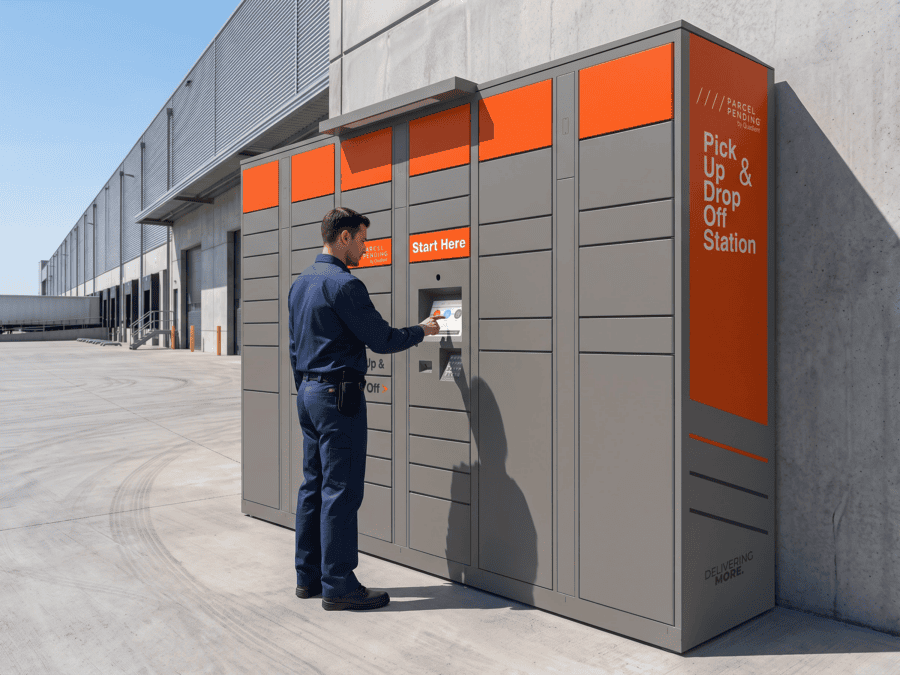
This is where Open Locker Networks, such as Parcel Pending by Quadient, can deliver value beyond consumer parcel collection and returns.
With an open locker network:
- Suppliers can deposit parcels at a time that suits their operation, without waiting for carrier collections
- 24/7 access reduces dependence on fixed collection windows
- Parcels accumulate into higher-density volumes at central locations
- Collection routes become more efficient and productive
- Chain-of-custody and parcel handovers become more consistent and trackable
- Suppliers can print and apply parcel labels before depositing items, reducing manual processing for logistics teams
However, the benefits extend beyond operational efficiency.
For carriers, consolidators and 3PL providers, open locker networks provide immediate access to an established national footprint of locations. Rather than investing in new sites, staffing and infrastructure, logistics providers can leverage existing network capacity to support growth, increase collection density and expand reach into new markets.
Instead of building additional infrastructure, they can focus investment on growing their business.
Rethinking the First Mile
Order consolidation has transformed how parcels move through modern supply chains, but some of the biggest opportunities for efficiency still exist upstream.
As logistics networks seek to reduce costs, improve scalability and maintain service performance, first-mile logistics deserves greater attention.
By creating more predictable, higher-density and structured parcel injection points, parcel locker networks can help remove inefficiencies before they enter the wider operation. Just as importantly, they provide a faster route to network growth by enabling logistics providers to access existing infrastructure rather than build it themselves.
Because when the first mile becomes more efficient, the entire network benefits. And when access to infrastructure is no longer a barrier to growth, scaling becomes significantly easier.
Key Takeaways
- First-mile logistics remains one of the most overlooked sources of inefficiency in many 3PL networks.
- Low-density collections increase transport costs and operational complexity.
- Fragmented intake can negatively impact consolidation, utilisation and last-mile performance.
- Parcel injection through shared access points can create a more scalable collection model.
- Open parcel locker networks can improve collection density, efficiency and visibility.
- Existing locker infrastructure enables logistics providers to scale operations and expand reach without significant capital investment.
Scale Your Operations Without Investing in More Infrastructure
Gain instant access to a national network of parcel locker locations that can help improve first-mile efficiency, increase collection density and support long-term growth.
Get in touch to discuss how Parcel Pending by Quadient’s open parcel locker network could support your network strategy.