Multifamily
How to Create an Apartment Package Policy Residents Will Follow
Written by: Parcel Pending
8 Min Read
Published: October 15, 2026
Updated: October 28, 2026
As Internet shopping soars, so do package deliveries at multi-family properties. Managing packages informally, haphazardly, or without a firm policy can lead to “he said/she said” liability issues. In this blog, we tackle why informal policies break down, the five components of an enforceable policy, and how to roll one out without alienating residents.
Key Takeaways
- A lack of a documented package policy leads to inconsistent processes, resident confusion, and lost or stolen packages
- To ensure your package policy is successful, define your desired liability position, then build a workflow that supports and enforces it
- Set clear pickup rules and holding timeframes so residents know when to collect packages and what happens if they don’t
- Train staff to enforce the policy consistently, since uneven enforcement undermines the policy as much as having no policy at all
Why Most Apartment Package Policies Fail (and What Residents Usually Push Back On)
As we dissect apartment package policy failures, we typically find that it isn’t a staffing issue, but a documentation issue. Pursuing a pattern of “that’s the way things have always been done” perpetuates a system that leaves you vulnerable to inconsistencies and liabilities that rear their heads in four key areas:
- No Documented Liability Language – Without clear terms for what’s accepted and what isn’t, properties are exposed to unnecessary liability
- No Chain of Custody Log – Without a record of when packages were received or picked up, “I can’t find my package” complaints become nearly impossible to resolve
- No Defined Holding Time Limit – Without a set collection window, storage areas fill up quickly and stay full longer
- No Resident Notification Protocol – Without a consistent way to notify residents, expect more “where’s my package” questions and more packages crowding storage areas
Package lockers have become the amenity residents actually use in apartment buildings, and the numbers make the case decisively. Among residents who’ve used lockers, smart package lockers rank as the number one amenity, ahead of business centers and clubhouses/common areas (tied for second) and pools/spas. Over 90% of locker users engage with the system weekly, and virtually all receive at least one package per week.1 That’s why a package management system is crucial at multifamily properties: residents interact with it more than almost any other amenity you offer, so an inconsistent process carries more reputational risk than most property teams assume.
In the following sections, we break down five steps to create a package management system that is smooth, reliable, secure, and easy for residents to follow.
Step 1: Define Your Liability Position Before You Write Anything Else
Your liability statement is the most legally consequential part of your apartment package policy. Be sure to establish, in writing, whether your property management team will accept packages on residents’ behalf and/or if you are doing so strictly as a courtesy with no assumed liability.
Your liability statement should also document any exclusions like signature-required items, oversized goods, live animals, hazardous materials, etc. Most multifamily properties also require renter’s insurance that covers delivery issues.
In your detailed documentation, remember to include any identification requirements or signature requirements for high-value items (PCs, tablets) or oversized items (TVs, mattresses) so that these exceptions are explicitly defined.
Are Property Managers Legally Required to Accept Packages?
Property managers/landlords are not legally required to accept packages. As such, you have the power to create policies and procedures that govern acceptance for your property specifically. Of course, putting these rules in a documented format, such as a package policy and/or as part of your standard rental agreement, helps staff and residents explicitly define and understand responsibility. We recommend contacting your attorney, your state/local apartment association, or the National Apartment Association for more legal guidelines, including specific lease addendum language.
Step 2: Choose a Delivery and Storage Workflow That Can Actually Support Your Policy
Here’s an example of where policy must meet reality – because your apartment complex’s current or planned infrastructure should be able to support the policy you’re creating. For instance, if you are implementing a policy that all accepted packages remain stored in a package room, you must have a package room large enough to handle the predicted volume. If not, the policy will quickly break down, reverting to informal processes that change depending on volume and staff.
If you’re not sending packages directly to residents’ doorsteps, here are the three most common methods for how to handle deliveries:
- Staffed Acceptance at the Leasing Office – Carriers deliver packages to leasing staff, who then store, sort, and deliver them to residents. This requires dedicated storage space, quickly eats into staff time, and limits residents to picking up packages during business hours.
- Unmonitored Package Room – Carriers deliver packages to a dedicated room where residents collect at their convenience. This still requires storage space, and unless it’s a smart package room, it offers minimal visibility into who accessed the room and when.
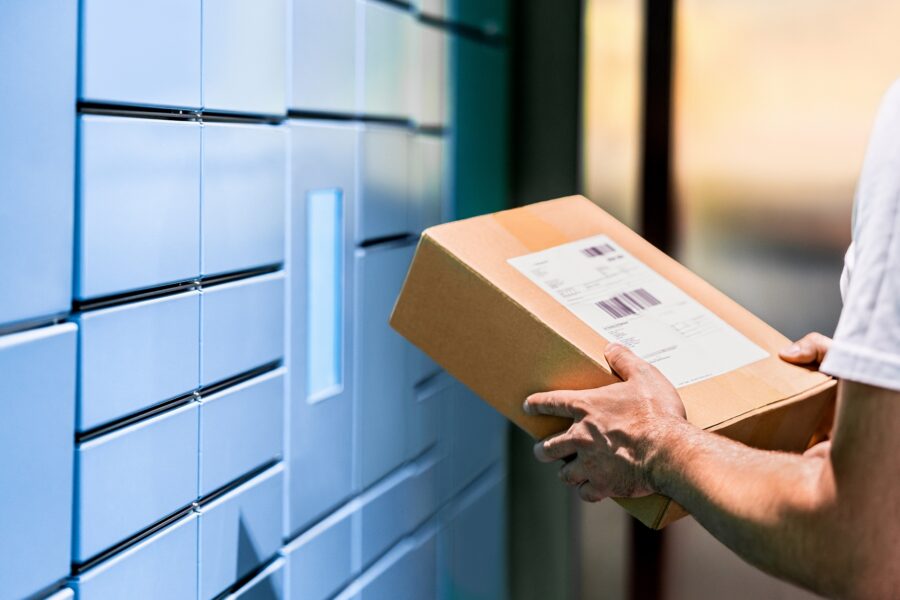
- Smart Lockers/Electronic Package Management – Carriers deliver directly to lockers and residents collect directly from them, with no staff involvement required. This makes the most of available space, maximizes delivery security, and gives residents access 24/7/365.
Package Delivery Workflow Models
| Workflow Model | Staffing Required | Security Level | Resident Access Hours | Enforceability of ID / Signature Rules | Best For |
| Staffed Leasing Office Acceptance | Yes; high-touch support | Medium | Business hours only | Yes | Small/low-volume properties |
| Unmonitored Package Room | Yes; minimal | Low | Building access hours | No | Very small properties only |
| Smart Locker / Electronic Parcel Management | No | High | 24/7/365 uninterrupted access | Yes (signature) | Small properties with high delivery volumes, all mid-to-large communities |
Access Control and Carrier Handoff Protocols
Your apartment package policy must address both carrier and resident requirements. Carriers, whether it’s USPS or private carriers like UPS, FedEx, or Amazon, need to know where to drop packages and what credentials they need if they are entering controlled areas (e.g., fob, access code). If carriers default to door drops despite documented policies requesting otherwise, your team may need to inform the carrier’s regional hub (or the local post office for USPS deliveries) that a package was dropped at the door and goes against your policy.
Note that smart locker systems allow carriers to deposit packages directly and safely without staff involvement.
Chain-of-Custody Logging: What to Record and Why It Matters
This is the most important step in your apartment package policy because it clearly tracks each step of package delivery. If logged correctly, this documentation stops the “where’s my package?” question right in its tracks.
If you’re accepting packages on residents’ behalf, your policy should specify what to log for each parcel delivery: delivery date and time, carrier, tracking number, unit number, and pickup confirmation. A manual log needs a standardized form, or the gaps in record-keeping can become a liability issue. A digital system, such as smart lockers, generates this information automatically.
Step 3: Set Resident Pickup Rules and Holding Timeframes
As we’ve made clear, holding packages for a resident is voluntary. Making the rules transparent is paramount for residents and staff to ensure they both understand who is responsible for what and when. Clear pickup rules and holding timeframes keep storage space consistently available and help prevent package theft or loss.
Most properties that accept packages through the leasing office or an unmanned, non-smart package room hold them for 5 to 10 days, while properties using parcel lockers or smart package rooms typically hold packages for just 2 to 3 days before assessing a small daily storage fee. Your policy should also document what happens once the collection window closes, whether that means returning the package to sender, transferring it to secondary storage, or disposing of it.
Notification Best Practices: Timing, Channels, and Escalation
To ensure resident compliance with your pickup rules and holding timeframes, your notifications and notification timing need to reinforce them. A sample notification schedule might look like this:
- An automated first notice triggered at the time of delivery acceptance
- A second notice 24 hours after delivery
- A third notice 48 hours after delivery
- A fourth notice 48 hours before the holding deadline with explicit consequence language
- A final notice 24 hours before return or removal, again with explicit consequence language.
Delivering notifications across multiple channels, such as both email and SMS, helps ensure residents don’t miss the alert. Smart lockers go a step further, sending daily reminder messages via email, SMS, or app to close any remaining gaps.
Step 4: Communicate the Policy So Residents Actually Read It
Once you’ve finished writing up your policy, it’s time to communicate it. Communicating your apartment package policy is not a “one-and-done” commitment. Instead, it must be part of the “move-in folder,” reiterated at lease renewal, listed in the resident portal, and reinforced by the leasing office. If your policy only lives in a lease addendum, it won’t be followed.
What to Include in Your Package Policy Signage at the Pickup Area
Don’t miss the opportunity to display signage at the pickup area. Your signage should include, at minimum, the property’s package holding period, pickup hours, ID requirement (if applicable), and contact information for questions. Posting these guidelines clearly near mailboxes and/or package areas helps ensure residents see and follow them.
Step 5: Train Staff to Enforce the Policy Consistently
If “good is the enemy of great,” as author Jim Collins wrote, inconsistency is the enemy of a solid apartment package policy. Policy documentation is worthless if leasing and other staff don’t enforce it consistently. In fact, it’s one of the most common reasons residents complain or fail to comply with documented policies.
If leasing staff accept packages, consider creating a reference card that outlines which packages they can accept, how to log them, what to say when residents ask questions, and when to escalate a situation to a senior staff member. You should also train staff on recurring friction points: residents who request collection extensions or exceptions, residents who claim they weren’t notified, and residents who request collection after their package has already been returned or discarded.
Handling Exceptions Without Undermining Your Policy
When exceptions do come up, whether for medical needs or documented travel, handling them well matters just as much as handling the standard cases. If exceptions happen frequently enough, document what’s permissible and create a formal exception request process. Staff should avoid ad hoc exceptions, since they set a bad precedent and erode staff authority to enforce the policy consistently for everyone else.
Bringing It Together: Turning Your Package Policy Into an Amenity, Not a Liability
Rather than creating stress or concerns, a solid apartment package policy aims to ensure residents understand it because they know how it works from day one. By establishing a clear liability position, building a workflow that can enforce it, defining pickup rules, communicating clearly with residents, and training staff to enforce the policy consistently, you set your property up for success.
Smart apartment package lockers can make enforcing a package policy even easier for property managers, automating package acceptance and logging, securing packages for residents, and allowing for 24/7 collection – all while automatically notifying and reminding residents to collect deliveries.
Discover how Parcel Pending’s multifamily smart locker solutions can help your policy framework run on autopilot. Speak to one of our package management experts to learn more about how to integrate smart lockers at your property.
Sources:
- Parcel Pending by Quadient. 2025 Resident Preferences Report. www.parcelpending.com. October 31, 2025. https://www.parcelpending.com/en-us/resources/2025-resident-preferences-report/