






Multifamily
2026 Multifamily Property Management Trends to Watch
Written by: Parcel Pending
10 Min Read
Published: December 25, 2025
Updated: March 18, 2026
In 2026, the multifamily property management industry finds itself at an inflection point. The new year demands strategies that stretch past leasing, resident service, and physical upkeep of the community to strategic investment, digital agility, and sustainable decision-making.
Whether you’re planning for new construction or managing existing properties, Parcel Pending by Quadient is here to help. This blog will break down the key property management industry trends reshaping multifamily housing in 2026 and explore what they mean for property managers, owners, and investors navigating the year ahead.
Multifamily Property Management Market Outlook for 2026
Multifamily Property Management in 2026
Current property management trends for 2026 show that the multifamily market is in transition. Supply additions peaked in 2024 when approximately 700,000 new units were delivered, breaking a 40-year record.1 This unprecedented construction boom has created softness in some key metros as they absorb the influx of new inventory. Meanwhile, construction starts and new permits are on the decline – and are on track to remain well below the pre-pandemic five-year average going into 2026.2
While the multifamily new development landscape is currently defined by scarcity and selectivity, projects started now will deliver into a stronger rent environment several years out. After years of muted increases, rent growth is expected to finally begin accelerating nationwide, rising approximately 1.9% by the end of next year.3 Significantly, low and mid-priced properties are projected to see stronger rent growth than luxury units, reflecting sustained demand at accessible price points.
Other Key Macro-Drivers Shaping 2026
There several other emerging trends shaping the multifamily property management industry in 2026, including:
- More Pressure on Margins: Getting new projects started remains difficult as financing remains tight and costs stay elevated.
- More Diverse Resident Needs: Meeting resident expectations continues to challenge communities, especially with more Gen Z and senior residents entering the market.
- More Pricing Justifications Required: Addressing residents’ affordability challenges means justifying higher rent costs through better community experience and a better amenity mix.
- More Automated Services Models: Rising labor costs will force technology investments ranging from operational enhancements to strategic necessities.
- More Environmental Regulations: Managing sustainability and ESG initiatives (from national and local government) will be critical to success in 2026.
Differentiating 2026 From Prior Years
Unlike previous years, 2026 sees a critical convergence of cost compression, heightened resident expectations, and digital transformation. Communities that adapt will outperform their competition in terms of Net Operating Income (NOI) and resident retention.
Read on to get our insights on the top five trends impacting the multifamily property management industry in 2026, as well as some actionable activities for modern property management firms.
Key Trend #1 – PropTech & Intelligent Automation
AI & Machine Learning
58% of successful property management companies already use artificial intelligence (AI) in their operations, and that figure is expected to climb significantly throughout 2026.4 AI applications are transforming daily operations: AI assistants enable 24/7 leasing support, tour scheduling, and lead qualification; predictive analytics allow for more accurate occupancy and rent forecasting; smart chatbots handle common resident requests.
As we move into 2026, the momentum around AI will be undeniable – especially when solutions can help cut costs, improve workflows, and free up staff time for higher-value resident interactions.
Predictive Maintenance & Operational Flows
Residents consistently rank maintenance repairs, security, and community appearance/cleanliness as their top priorities.5 Now, smart technology is transforming how properties meet these expectations. For instance, Internet of Things (IoT) sensors deployed throughout the community can help property teams detect HVAC issues, water leaks, and electrical faults before they escalate. Further, automated work order generation triggered by these sensors can reduce administrative burden on property staff.
Predictive systems like these can cut equipment downtime, extend the lifetime of expensive assets, and, most importantly, improve resident satisfaction by minimizing disruptions.
Integrated Tech Stacks
Integrated technology stacks can add to the benefits already offered by AI and predictive tools. For example, API-driven integrated platforms can connect disparate systems for end-to-end property oversight. These smart property management tools also offer dashboards that unify maintenance, leasing, communication, and operational management reporting to stay ahead of emergencies and help reduce downtime. These integrations are critical to help property operations run more efficiently.
Key Trend #2 – Resident Experience as a Competitive Advantage
Self-Service Expectations
Today’s residents expect frictionless, digital experiences across every interaction from rent payments to maintenance requests to amenity reservations. This expectation is particularly pronounced among younger renters, for whom online resident portals, mobile apps, and smart building features rank among the top decision factors when choosing where to live.
Move-In & Lease Renewal Experiences Drive Retention
The first 30 days a resident spends at their community often define their long-term satisfaction; automation and digital tools can help ensure a smooth onboarding process. Self-guided tours, online lease signing, and instant access to community package management are all must-haves for new residents.
Key Features and Preferences to Attract Millennials & Gen Z
Younger residents’ expectations for tech-enabled living experiences, community engagement opportunities, and sustainable features are reshaping what defines a competitive property. Pet amenities, smart technology (e.g., digital access systems, smart thermostats, and smart package lockers), wellness programs, and flexible lease terms also rank among the top decision factors for these demographics. Multifamily communities looking to deliver an outstanding resident experience should consider implementing these features to attract younger renters.
Differentiating Your Community in a Competitive Market
According to a myQ Community survey, overall friendliness when interacting with staff ranks as the number one resident priority.6 Properties looking to prioritize interpersonal excellence can do so by encouraging community-building with digital engagement tools and offering personalized services to make day-to-day interactions and maintenance processes feel seamless and reliable.
Key Trend #3 – The Secure Delivery Ecosystem
The Problem of Package Overload
With e-Commerce expected to account for more than 20% of retail sales in 2026, package handling has become one of the top operational drains for on-site staff.7 Logging, sorting, storing, notifying, and delivering packages for residents eats up a lot of time very quickly; property staff spend an average of 30 hours per week managing packages, time that could be dedicated to resident engagement, property improvements, or leasing activities.
Yet residents, especially millennial and Gen Z residents, expect 24/7 secure, self-service access to their packages. The gap between resident expectations and traditional package handling capabilities has never been wider. Enter the smarter solution to package management: parcel lockers.
Smart Package Lockers: A New Standard
Apartment package lockers have become a must-have amenity for communities looking to create a secure, modern living experience that meets resident expectations while solving operational challenges. The benefits are multi-dimensional:
- MORE Access: Residents can collect package deliveries at their convenience 24/7 – no more waiting in line at the leasing office
- MORE Efficiency: Staff no longer need to manually handle packages, allowing them to focus on property management
- MORE Retention: Lockers’ reliability and convenience drive resident satisfaction and therefore improve resident retention
- MORE Security: Lockers keep residents’ packages safe from porch pirates, logging each delivery and pickup
Parcel Pending by Quadient also offers turnkey integrations with most major property management software systems, making implementation straightforward.
Specialized Deliveries & Futureproofing
Communities with scalable, versatile locker systems will be future-ready as delivery types continue to diversify. For instance, refrigerated lockers can provide climate-controlled storage for perishable items such as groceries, temperature-sensitive medications, and fresh flowers, as well as subscription services, addressing residents’ evolving needs for fresh food delivery and healthcare convenience. Parcel Pending offers refrigerated solutions as well as oversized lockers and locker-controlled package rooms to accommodate oversize (e.g., furniture) or overflow packages.
Key Trend #4 – Sustainability and ESG
Why Sustainability Matters for Multifamily Property Managers
Multifamily investment firms are increasingly using sustainable and environmental, social, and governance (ESG) factors as criteria to guide their investment decisions, while properties themselves are using these investments to attract eco-conscious residents. Gen Z, for instance, isn’t just talking about sustainability; they’re voting with their wallets. Recent Afterpay research shows a third of Gen Z consumers cut ties with brands that didn’t meet their environmental standards, while nearly half (49%) actively chose sustainable products.8 “Sustainability is the new amenities race,” notes Noel Carson of The Bozzuto Group, and multifamily properties must keep pace.9
Sustainable Building Technologies to Watch
Modern eco-friendly property management extends far beyond LED lights and low-flow fixtures. Connected thermostats control energy usage based on occupancy and weather patterns. Motion sensors trigger lighting, heating, and blinds in common areas and vacant units. The most advanced systems employ AI for predictive analytics, alerting maintenance teams before issues escalate.
Water conservation technology has become particularly sophisticated. Leak detectors, automated shut-off valves, and smart meters work together to create intelligent, manageable water management platforms, while connected appliances further optimize conservation. According to a Johnson Controls survey of the company’s Building Efficiency Panel, 70% of respondents believe that the ability to predict and diagnose problems and provide or propose solutions will be a “game changer” for property operations.10
Key Trend #5 – Managing Cost Pressures with Operational Efficiency
Rising Costs and Margin Compression
Multifamily properties face a challenging cost environment in 2026, with pressures coming from multiple directions. CBRE’s 2025 market outlook anticipates a slight decline in multifamily cap rates, projecting a 17-basis-point decrease from their 2024 peaks.11 Beyond capital market dynamics, operational expenses continue to rise, labor shortages persist across the industry, insurance premiums remain elevated, and materials inflation, while moderating from pandemic-era peaks, continues to impact maintenance budgets and capital improvement projects.
All of these factors combined mean that multifamily property owners are increasingly expecting property managers to do more with less, driving further demand for centralized operations.
Strategies to Defend Margins
In this environment of margin compression, technology investment has shifted from optional enhancement to strategic necessity. Automation and data-efficiency tools help smaller teams to manage larger portfolios more effectively. Smart building systems reduce energy costs. Predictive and preventive maintenance platforms extend equipment life and prevent costly repairs. And AI-powered leasing tools provide 24/7 prospect engagement without additional headcount.
Successfully Balancing Growth and Efficiency
The properties that thrive in 2026 will be those that strategically deploy technology not as a replacement for human touch, but as a force multiplier that allows staff to focus on high-value activities while automated systems handle routine, day-to-day operational tasks. This approach maintains service quality while controlling costs and successfully meeting resident needs, therefore improving operational efficiency and increasing resident satisfaction.
Actionable Recommendations for Property Management Firms
Reviewing trends is only valuable if you act on them. Here’s a phased approach to positioning your properties for success in 2026 and beyond.
Quick Wins (Within 12 Months)
Start with high-impact, relatively fast implementations that deliver immediate results. Digital resident portals, maintenance automation tools, AI leasing assistants, and smart package lockers require modest investment but generate measurable returns quickly through reduced operational costs and enhanced resident experience.
Medium-Term (18-36 Months)
Once foundational systems are in place, expand into more sophisticated technology integrations. Implement IoT or other connected systems, then consolidate data into unified dashboards that give leadership clear visibility into property and/or portfolio performance. This allows teams to identify trends, benchmark properties, and make strategic decisions backed by comprehensive analytics.
Long-Term (3-5 Years)
Position your organization to achieve and maintain a competitive advantage by transitioning to full-lifecycle asset management models that optimize long-term performance from acquisition through disposition. You can also consider expanding into new property types or markets where your operational expertise and technological infrastructure give you an advantage. This is also the time to invest in comprehensive sustainability initiatives or building retrofits. These longer-term investments require significant capital and planning but can fundamentally strengthen your competitive position.
Key Performance Indicators to Monitor
Success requires measurement. Tracking these KPIs can help you gauge progress and identify areas needing attention:
- Resident Satisfaction and Retention – The ultimate measure of whether investments are delivering value that residents recognize
- Cost per Managed Unit – Essential for understanding operational efficiency as technology and automation scale
- Technology Adoption Rate – Track how quickly residents and staff embrace new tools; low adoption may signal the need for better training or different solutions
- Energy Consumption per Square Foot – Monitors sustainability progress and identifies opportunities for cost reduction
Regular review of these metrics allows you to course-correct quickly and demonstrate ROI to stakeholders.
Delivering MORE for Residents in 2026
2026 marks a defining moment for multifamily property management. Leaner teams, smarter systems, and heightened resident expectations are converging to separate industry leaders from those struggling to keep pace. The margin for error has never been smaller, but neither have the opportunities been greater for properties willing to evolve.
The question now isn’t whether to invest in smart building systems, AI-powered operations, sustainable infrastructure, smart package management solutions, and resident-centric technology; the question is how quickly you can implement these solutions before your competitors do. The properties that dominate 2026 and beyond will be those that recognize these multifamily property management industry trends and act on them with urgency and strategic vision.
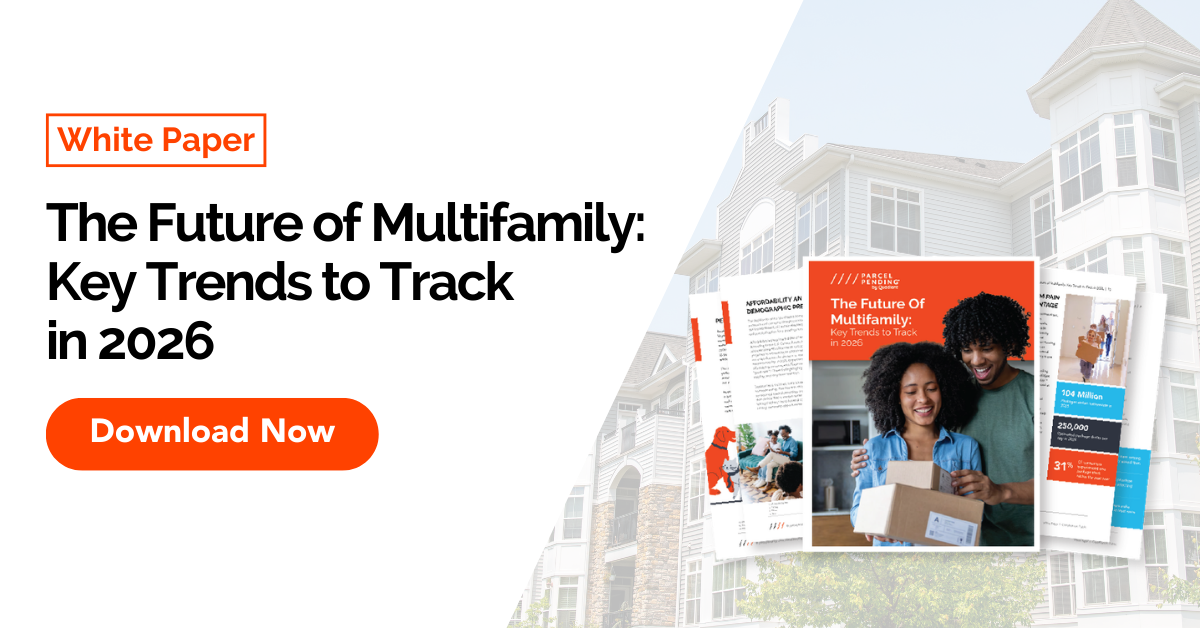
To learn more about which trends are shaping the multifamily industry in 2026, click the image below to download our full white paper:
Sources:
- Apartments.com. What’s Ahead for Multifamily: 11 Trends to Watch in 2026. www.apartments.com. October 17, 2025. www.apartments.com/grow/learning-center/2026-multifamily-trends
- Ibid.
- Ibid.
- Young, Robin. The 2026 State of the Property Management Industry Report. www.buildium.com. n.d. https://www.buildium.com/resource/2026-property-management-industry-report/
- Zego. 6 Property Management Trends for 2026. www.gozego.com. n.d. https://www.gozego.com/articles/property-management-trends/
- Chamberlain Group. New Study Reveals Keys to Retaining Renters in a High-Turnover Market. www.prnewswire.com. October 28, 2025. https://www.prnewswire.com/news-releases/new-study-reveals-keys-to-retaining-renters-in-a-high-turnover-market-302596622.html
- Lebow, Sara. Ecommerce to account for more than 20% of worldwide retail sales despite slowdown. www.emarketer.com. May 22, 2025. https://www.emarketer.com/content/ecommerce-account-more-than-20–of-worldwide-retail-sales-despite-slowdown
- Afterpay. Beyond the Crocs & TikToks: How Gen Z Are Shopping (U.S. Edition). afterpay-newsroom.yourcreative.com.au. n.d. https://afterpay-newsroom.yourcreative.com.au/wp-content/uploads/2022/11/Afterpay-Gen-Z-US-Report-2022.pdf
- Kraus, Blake. For Gen Z, Sustainability Is the New Amenities Race. www.multifamilyexecutive.com. June 10, 2020. https://www.multifamilyexecutive.com/design-development/for-gen-z-sustainability-is-the-new-amenities-race_o
- Deloitte University Press. Smart buildings: How IoT technology aims to add value for real estate companies. ww2.deloitte.com. 2016. https://www2.deloitte.com/us/en/insights/focus/internet-of-things/iot-commercial-real-estate-intelligent-building-systems.html
- Quach, Aaron. Multi-Family Market Faces Both Risks and Opportunities. www.callan.com. March 14, 2025. https://www.callan.com/blog/multi-family-market/