





University
Smart Lockers: Modernizing Campus Bookstore Operations
Written by: Parcel Pending
4 Min Read
Published: August 19, 2024
Updated: March 30, 2026
Enrollment Decline: The Shifting Landscape of Higher Education & Spending
Higher education institutions are facing significant headwinds. Undergraduate enrollment has fallen more than 8% from its 2010 peak, and experts project continued sharp drops through the next decade.1 At the same time, federal and state funding cuts are forcing institutions to make difficult budget decisions, from hiring freezes to program reductions. Further, the shift towards digital learning means students are spending less on physical reading materials and classroom resources. According to independent research from Student Monitor, student spending on course materials has declined more than 50% over the past decade, reaching its lowest level since tracking began.2
Facing pressure on multiple fronts, institutions are looking harder at ways to uncover new revenue and get more out of what they already have, including the campus bookstore. Here are ways to leverage smart lockers to streamline your campus bookstore operations and increase revenue.
Four Key Benefits of Smart Lockers
More Convenient
Smart lockers reduce wait times and improve the student experience. Students and other bookstore customers can pick up orders on their schedule; depending on the location, pick-up might be available 24/7/365. With pickup times as quick as 7 seconds, it’s no surprise that 95% of locker users are likely to become repeat customers.
More Efficient
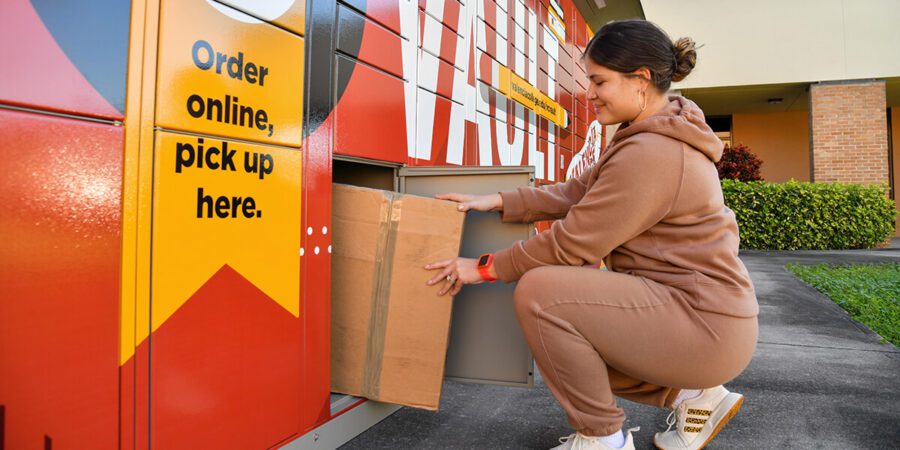
Smart lockers increase efficiency, as Valencia College in Florida can attest. Its journey to operational excellence began with challenges posed by the pandemic. Initially struggling with unsustainable shipping costs and inefficient in-store pickup methods, the college found a game-changing solution in smart lockers, dubbed “the VC Vault”. Valencia significantly reduced its reliance on manual labor by automating the order pickup process. The system eliminated the need for the additional 20–30 workers per shift that were previously required for curbside delivery, freeing up resources and streamlining operations. Campus Store Manager Frankie Ortiz noted the stark improvement: “We didn’t have to deploy a small army to make sure that every student is prepared on that first day of class.” The results backed him up — Valencia achieved a 94% student pickup rate within 24 hours and saved $500,000 in shipping costs in its first fiscal year alone.3
The VC Vault acted as a catalyst for leveraging this technology beyond bookstore operations. The library adopted the system as a central book distribution center, enhancing its service capabilities. Plans to integrate the food pantry into the VC Vault network demonstrate the system’s versatility in addressing student needs.
More Revenue
Students collecting online orders from lockers are re-entering the bookstore environment and can be presented with additional sales opportunities. Recent PYMNTS revealed that nearly half (47%) of U.S. consumers say they wind up buying more when they come to collect eCommerce orders in-store or curbside; another 17% say they purchase additional items when picking up orders some of the time.4
Additionally, strategically assessing the lockers’ location can boost revenue. Due to the Commons Dining Hall expansion, Rensselaer Polytechnic Institute (RPI) in Troy, New York, had to relocate its mail center. By shifting it to the student union, revenue for the student center and bookstore jumped 8%.
More Engagement
The University of Pittsburgh, globally renowned for innovation and academic excellence, implemented a creative smart locker system that works as a special promotion and boosts student and parent engagement: the “birthday locker” initiative. Parents arrange for Pitt-branded merchandise to be placed in these lockers for their children’s birthdays. On their special day, students receive a notification to collect their gift from a designated locker. Upon opening, the locker plays “Happy Birthday,” adding a personalized touch to the experience.
Revolutionizing Returns: Campus Stores Get Smarter
Enhancing the campus store experience extends beyond skilled staff and quick checkouts. It also encompasses efficient returns processes, a change that benefits both customers and employees. Smart technologies, particularly smart parcel lockers, can revolutionize returns management in campus stores by simplifying reverse logistics.
How the Returns Process Works with Smart Lockers
The returns process for the customer takes less than 30 seconds from start to finish:
- The customer receives a personalized QR code via email.
- The customer scans the return QR code, and a locker door automatically opens for them.
- Once the item is placed inside the locker and the door is closed, the customer receives a confirmation receipt for the returned item.
- A campus store employee retrieves the returned item and completes the return logistics process.
Cultivating Additional Revenue Streams
Colleges are partnering with vendors to expand their offerings. The University of Georgia works with Barnes & Noble to manage its three retail outlets and official campus bookstore.4 Institutions are also transforming campus spaces into multifunctional hubs to lift foot traffic and student engagement, seamlessly blending dining facilities with pop-up retail, cutting-edge technology centers, and diverse communal areas. Cornell University’s bookstore leverages AI-driven technology to provide tailored product recommendations, enhancing the shopping experience. Interactive digital displays create a dynamic, ever-changing environment that informs, entertains, and increases sales.6
In an era of declining enrollment trends, lower student spending, and the need to retain the relevance and revenue of campus bookstores, smart lockers emerge as a game-changing investment.
Ready to deliver more for your campus store customers? Speak to a Parcel Pending representative today.
Sources:
- Conley, Jordan. US College Enrollment Decline – 2024 Facts & Figures. www.collegetransitions.com. April 22, 2024. https://www.collegetransitions.com/blog/college-enrollment-decline/
- National Center for Education Statistics (NCES), via BestColleges Research. College Enrollment Decline Statistics. March 2025. / AGB, The Enrollment Cliff. November 2025.
- Parcel Pending. Higher Ed and Parcel Management Leaders Explore the Real-Life Impacts of Smart Lockers on Campus: 4 Key Takeaways. www.parcelpending.com. June 17, 2024. https://www.parcelpending.com/en-us/blog/higher-ed-and-parcel-management-leaders-explore-the-real-life-impact-of-smart-lockers-on-campus-4-key-takeaways/
- PYMNTS. BOPIS Grows Basket Size as Most Consumers Buy Extra Items When Picking-Up In-Store. www.pymnts.com. April 19, 2022. https://www.pymnts.com/news/retail/2022/bopis-grows-basket-size-as-most-consumers-buy-extra-items-when-picking-up-in-store/
- Glasergreen, Eve. The Evolving Role of the Campus Bookstore. www.higheredjobs.com. May 21, 2024. https://www.higheredjobs.com/Articles/articleDisplay.cfm?ID=3921&Title=The%20Evolving%20Role%20of%20the%20Campus%20Bookstore
- Ibid.