




University
How to Overcome Barriers to Food Access on Campus
Written by: Parcel Pending
5 Min Read
Published: October 15, 2025
Food insecurity on campus isn’t going away. In fact, the problem continues to intensify as students struggle with rising tuition costs, growing economic uncertainty, skyrocketing food prices, and shrinking federal financial aid. Yet many students in desperate need aren’t getting assistance, whether because of the stigma attached to asking for help or simply not knowing where to go for support. When students can’t easily access reliable and nutritional meals, the consequences ripple far beyond empty stomachs, directly impacting institutional reputation, enrollment numbers, matriculation rates, and student satisfaction scores.
This blog explores practical strategies to break down food access barriers – including a downloadable eBook packed with deeper insights on addressing food insecurity in higher education.
Overcoming Food Insecurity Stigmas
It’s hard to convey the stigma that students can feel when asking for help, but it is a contributor to why fewer students are willing to raise their hand and request assistance. Feelings of isolation play a significant role, as do growing mental health challenges. 35% of students considered leaving their program in the last six months, with 53% citing emotional stress and 43% citing mental health as primary reasons.1 This comes as reports of 18-to 25-year-olds experiencing loneliness surge.2
The data becomes even more revealing when you consider that nearly half of all students in a recent US study reported experiencing food insecurity according, yet only 17% stated that they shopped at a food pantry. Further, 30% believed other students needed the food more than they did, while 21% felt embarrassed about using the service.3
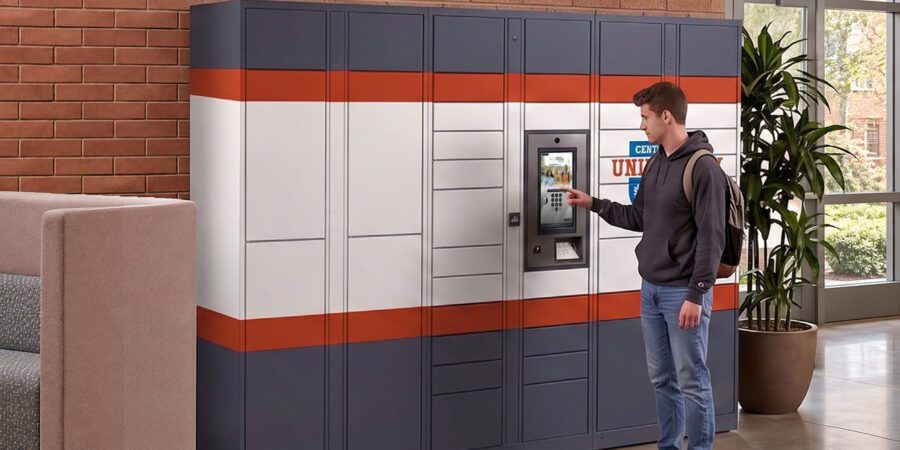
A shining example of how to approach food insecurity with dignity is Bunker Hill Community College and its successful DISH (Deliver Information, Sustenance, and Health) initiative. It adopted Parcel Pending smart lockers as an “invisible” way to deliver food and other key supplies. As Rob Zinsky, Vice President of Business Development at Parcel Pending by Quadient, summarizes: “Individuals obviously are sensitive about going into the food pantry, so the ability to order a meal online and pick it up discreetly in a locker anytime they want can be game-changing.” In 2024 alone, the DISH Food Pantry program distributed over 95,000 pounds of food, fulfilled more than 35,000 Grab-and-Go visits, and facilitated over 1,400 locker pickups. Of the locker pickups, nine in 10 users rated the food quality as “excellent” or “good.”
Adding Convenience and Accessibility to Food Services
The profile of a typical college student is shifting. Whereas before most students entered college immediately after high school, lived on campus, and took a full course load, today’s population is more diverse and mature, as well as more likely to attend classes part-time while holding down a job or supporting other family members. These shifts translate into added difficulty in accessing food programs during “standard” service hours.
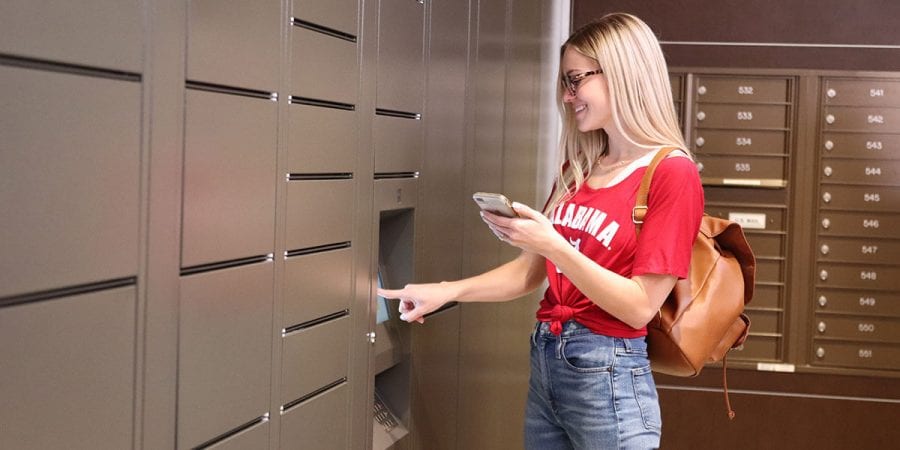
Enter smart lockers that allow students to retrieve food on their schedule, even outside regular dining services hours. When implemented as part of larger distribution hubs around campus, students can access lockers without telegraphing to others that they are receiving aid. Furthermore, leveraging locker systems as a distribution system for food and other supplies (e.g., textbooks, campus store purchases, etc.) bolsters efficiency, as no extra staffing is required to support collections.
Finding Funding for Your Campus Food Pantry
In the current climate, it can feel difficult to find funding for capital expenditures. While there’s no central clearinghouse identifying ways to raise funds for meals, there are still options out there for colleges and universities to secure funds. Here are a few ideas:
- State Funding: Roughly a dozen states have passed “Hunger Free Campus” legislation, which sends funding to public schools addressing student hunger on campus.
- National and Local Programs: Organizations like Swipe Out Hunger partner with colleges to alleviate student hunger and will continue to offer grants in the 2025-2026 period. Since 2021, Swipe Out Hunger has distributed $929,000 in grants to campuses.4 As a Swipe Out Hunger partner, Parcel Pending by Quadient is providing exclusive discounts to member campuses looking to implement lockers as part of their food pantries; speak to a Parcel Pending representative for more information.
- Donations – Food banks, local grocery stores, restaurants, and more can all be partners in securing additional supplies.
- Pooling Departmental Resources – With solutions like smart lockers, which can act as a distribution system for multiple departments and services across campus (e.g., library, bookstore, bursar, and student housing), it’s often easier to make a strong case for securing funding by pooling resources.
Deliver More for Students with Smart Lockers
Implementing a food pantry locker system with connected campus technology can help your institution manage costs and generate economies of scale. Parcel Pending by Quadient’s Campus Hub™, for instance, is an innovative solution that transforms university campuses into fully integrated distribution networks. The concept is simple: smart parcel lockers serve as centralized exchange points for a wide range of goods and items across campus.
By combining Quadient’s Web Tracking System (WTS) or your existing asset tracking software with our smart locker solutions, Campus Hub creates a seamless, end-to-end chain of custody for all distributed and received items, including food pantry order pick-ups. This can help your mission-driven efforts integrate seamlessly with other campus initiatives – all while providing ongoing insight into success metrics.
Countering food insecurity is a top priority across college campuses. Smart lockers can remove the stigma of receiving food assistance while also supporting other departments, such as the bookstore and library. Most importantly, stable food sources for college students increase engagement, enrollment, retention, and graduation rates.
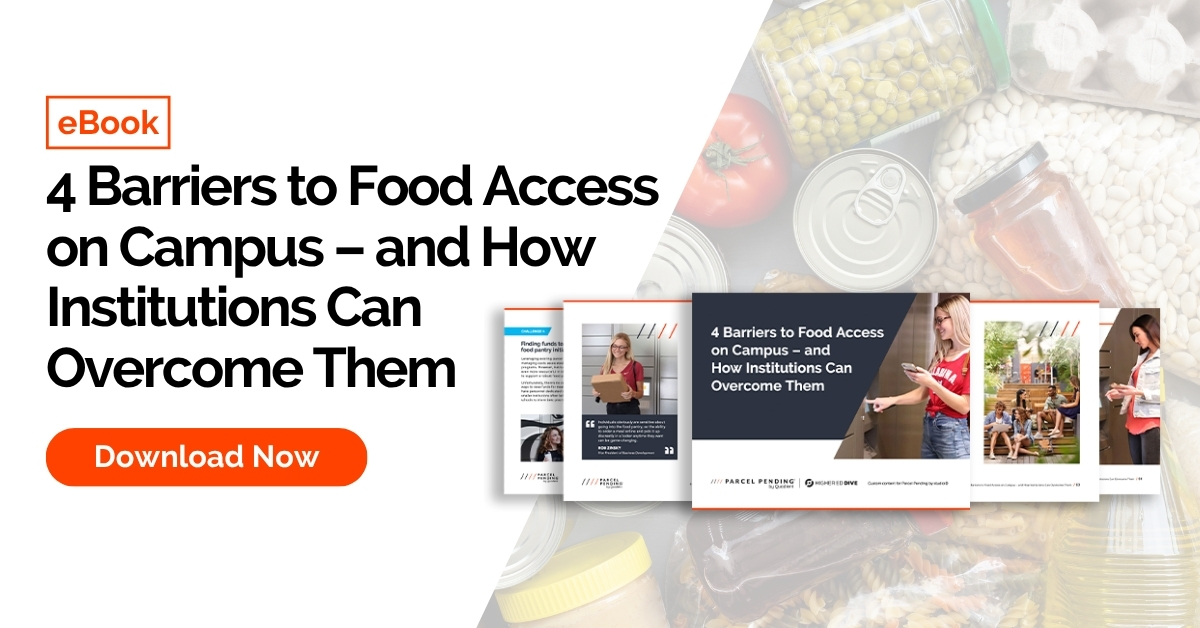
If you’re ready to discover how a smart locker system can work at your institution, please click the image below to download our eBook, “4 Barriers to Food Access On Campus – and How Institutions Can Overcome Them”, for more insights on food insecurity in higher education.
Sources:
- Griffin, Alison. Colleges and Universities Are The Front Lines Of Mental Health Support. www.forbes.com. May 30, 2024. https://www.forbes.com/sites/alisongriffin/2024/05/30/colleges-and-universities-are-the-front-lines-of-mental-health-support/
- Caulfield, John. Recreation and wellness are bedfellows in new campus student centers. www.bcdnetwork.com. October 15, 2024. https://www.bdcnetwork.com/home/news/55237393/recreation-and-wellness-are-bedfellows-in-new-campus-student-centers
-
McArthur, Laura H et al. “Use and Perceptions of a Campus Food Pantry Among Food Insecure College Students An Exploratory Study from Appalachia.” Journal of Appalachian health vol. 2,2 7-23. 15 Apr. 2020, doi:10.13023/jah.0202.02
- Raymundo, Janelle. Swipe Out Hunger Awards Over $200,000 In Grants to 70 Colleges. swipehunger.org. February 4, 2025. https://swipehunger.org/swipegrants2024/