





Our Blog
5 Trends Reshaping Campus Operations in 2026-2027
Written by: Matt Shamshoian
9 Min Read
Published: July 9, 2026
Updated: October 14, 2026
Key Takeaways
- AI adoption among students is near-universal and moving faster than most institutions can write policy for, with operational uses already extending past the classroom into enrollment forecasting and admissions support.
- Mental health and food insecurity have become campus-wide infrastructure challenges, with the main bottleneck being awareness and ease of access rather than funding or program design.
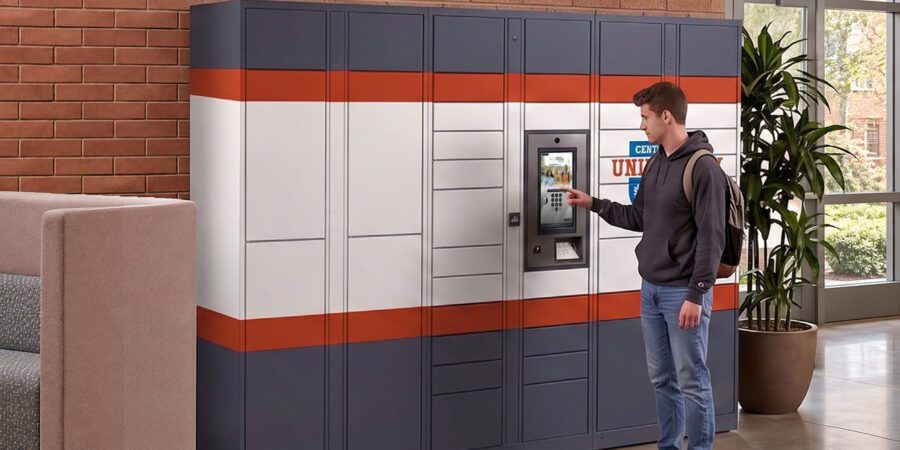
- The package surge has outgrown letter-era mailroom workflows, and the institutions getting ahead are treating self-service lockers as a distribution layer that serves more than one department.
- Gen Z evaluates campus services against the apps they grew up with, and meeting that bar tends to drive immediate adoption when institutions get it right.
Higher education is changing faster than its operating models were built to absorb. The shifts rarely arrive one at a time, and they rarely stay confined to one department. A new technology that lands in the classroom usually creates work somewhere else within weeks, and the people handling it are often the same ones already stretched thin by rising student demand, flat budgets, and headcounts that haven’t grown in years.
Pressures from different angles adding up is the real story heading into the 2026-27 academic year. When you take them individually, these shifts aren’t new. What’s changed is that they are all landing at once, on the same staff, in the same buildings, funded by the same tight budgets. The campuses managing added pressures well have stopped treating each change as a separate problem for a separate office. Instead, they are looking at where the demands overlap and fixing the shared infrastructure and processes underneath.
In this article, we’ll explore five shifts reshaping how campuses operate, and where the smartest operational bets are heading.
1. AI is reshaping both teaching and back-office operations
Students settled the artificial intelligence (AI) adoption question on their own. By the time most institutions finished drafting their first AI guidelines, 86% of students were already using AI in their coursework, more than half of them weekly.¹ Faculty weren’t far behind, with the majority now using generative tools to build course materials and assess student work.
Institutions are now wrestling with everything that comes after adoption, from academic-integrity policies to the gaps between students with access to the best tools and those without. In one 2025 survey, 83% of faculty said they worried students couldn’t critically judge what AI was handing them.²
The AI shift reaches well past the classroom. For lean teams, the predictive tools that flag an at-risk student before midterms are also forecasting enrollment and clearing the routine admissions questions that used to tie up staff. The institutions getting ahead are writing their rules now, while the technology is still moving, rather than reacting to each new tool as it lands.
2. Mental health demand is outpacing the systems built to meet it
Most campuses have expanded mental health support in recent years. The harder problem is that students often don’t know it exists. Two in three students are unaware of the services their campus already offers, and a quarter of those who do know avoid them, assuming the resources are too stretched to help.³
That gap turns a well-funded program into one that goes unused. It also pushes the work back onto staff who weren’t hired for it, from RAs to academic advisors fielding conversations they aren’t trained to have.
The fix is rarely another program. Instead, it’s making the support already in place easier to reach and less conspicuous to use. The institutions making real progress are closing the distance between the help they offer and the students who need it. For instance, some campuses now route wellness resources and medication pickup through smart lockers, so a student can collect what they need on their own schedule without a front-desk conversation or a visible line outside the counseling office.
3. Food insecurity has become an operational issue, not just a student-services one
Surveyed college students experienced food insecurity.
The Hope Center’s 2023–2024 Student Basic Needs Survey found that 41% of respondents experienced food insecurity.
Food insecurity now affects close to four in ten students at four-year institutions and nearly half at community colleges.⁴ At that scale, a campus pantry stops being a charity shelf and starts being a distribution operation.
At Bunker Hill Community College, the DISH Food Pantry logged more than 35,000 visits and filled thousands of grocery orders in a single year – more than a staffed counter could handle during business hours alone.⁵ In response, the college moved pickup into smart lockers, letting students collect orders on their own time in a setup built to feel like a normal grocery run rather than a handout.
That last part matters as much as the logistics. The same stigma that keeps students from counseling keeps them from using campus food pantries, and a private, self-service pickup removes the part they dread most. The campuses treating food access as core operations, with the tracking and capacity that implies, are reaching students older food pantry distribution models quietly leave behind.
4. The on-campus delivery surge has outgrown letter-era mailrooms
US e-commerce passed $1.2 trillion in 2025⁶ and is on track to climb another 10% this year.⁷ Every one of those packages has to land somewhere, and on campus that “somewhere” is, more often than not, a mailroom built for an era of letters and the occasional, small box.
That was the case at the State University of New York at Albany, where a 400% increase in package volume, combined with budget constraints, pushed the mailroom and its staff past their capacity.⁸ To address the challenge, the university turned to smart lockers, which typically cut mailroom labor by as much as a third⁹. After installing Parcel Pending by Quadient smart lockers, the university extended service hours to 7 a.m. through 11 p.m., up from 7 a.m. to 3 p.m. Data showed that the percentage of pickups after the old 3 p.m. closing time was significantly higher than the percentage of pickups before 3 p.m.
Universities are thinking about how they can implement lockers to make other departments more efficient and accessible for students. The State University of New York at Albany expanded locker usage to the library, and now other departments are thinking about implementing lockers too. Universities like the University of South Carolina are using lockers in a variety of ways, including course material pickup in the campus store, prescription pickup at health services, and game-day apparel at the stadium.¹⁰ The campuses thinking this way treat lockers as a distribution layer the whole institution can run on, not just a better mailroom.
5. Gen Z expects campus services to work like the apps they grew up with
This is the generation raised on tracking a burrito across town in real time and getting answers from an app at 2 AM. They arrive on campus expecting the same from everything else, and services that run on a 9-to-5 counter and a paper form reads as broken to them, not just inconvenient.
A service that falls short of that standard often goes unused. Research has linked use of campus support services to retention, with students who don’t take advantage of the services consistently less aware of the resources their campus offers.¹¹
The upside is that students take to services built around their expectations. When USC moved course-material pickup to self-service lockers, roughly 90% of a recent cohort had used them within the year.¹² Meet the standard students already live by, and adoption takes care of itself.
What this means for campus leaders
None of these trends resolves on its own, and the institutions that treat them as five separate fires will spend the academic year running between them. The ones that pull ahead will see how much the trends overlap and adapt accordingly. A student who expects 24/7 access to a package expects the same from a food pantry order or a prescription pickup, and a campus that builds that access once, then shares it across departments, solves several problems at once.
Read our Campus Operations Playbook to see how leading campuses are building the shared infrastructure that supports student demand for convenience while streamlining institutional operations.
Frequently Asked Questions
What are the biggest operational challenges facing higher education in 2026-2027?
The most pressing operational challenges include AI adoption outpacing institutional policy, mental health and food insecurity programs failing to reach students who need them, package volumes overwhelming legacy mailrooms, and Gen Z’s expectation for 24/7 self-service across campus. These trends aren’t new individually, but they now land simultaneously on the same teams, budgets, and buildings.
How are colleges and universities using smart lockers beyond mail and packages?
Institutions are extending university smart lockers into food pantry distribution, medication and wellness resource pickup, course material fulfillment, library materials, IT equipment lending, prescription drop-offs at health services, and even game-day apparel. The University of South Carolina and the State University of New York at Albany are two examples of campuses treating lockers as a distribution layer that multiple departments use, rather than a single-purpose mailroom tool.
Why is student awareness a bigger problem than program availability?
Most campuses have expanded mental health, food insecurity, and academic support programs over the past several years, but two in three students remain unaware of the services their institution already offers. Research also links service usage directly to retention. Students who stop out are consistently less aware of available support. This means investment in program awareness and easy access often delivers more impact than launching additional programs.
How much can smart lockers reduce mailroom labor?
Smart lockers typically cut on-campus mailroom labor demand by as much as one-third by moving fulfillment out of staffed hours and into 24/7 self-service pickup. Institutions extending locker use to other departments compound those savings by consolidating fulfillment infrastructure that would otherwise be duplicated.
What should campus operations leaders prioritize for the 2026-2027 academic year?
The strongest operational bet is looking for overlap between challenges rather than treating each as a standalone problem. A student expecting 24/7 access to a package expects the same from a food pantry order or prescription pickup, so building shared self-service infrastructure once and extending it across departments solves multiple problems at once. This approach also reduces the burden on staff who are already stretched thin.
How is AI changing back-office operations in higher education?
Beyond the classroom, predictive analytics tools are being used to flag at-risk students before midterms, forecast enrollment trends, and handle routine admissions inquiries that previously tied up staff. Institutions writing clear AI policies now, while the technology continues to evolve, are better positioned than those reacting to each new tool as it lands.
Get the playbook for what comes next.
See where to start and how leading campuses are building the shared infrastructure these trends keep pointing to.
Sources
- Digital Education Council. Global AI Student Survey 2024. digitaleducationcouncil.com. n.d. https://www.digitaleducationcouncil.com/post/digital-education-council-global-ai-student-survey-2024
- Digital Education Council. What Faculty Want: Key Results from the Global AI Faculty Survey 2025. digitaleducationcouncil.com. n.d. https://www.digitaleducationcouncil.com/post/what-faculty-want-key-results-from-the-global-ai-faculty-survey-2025
- Parcel Pending by Quadient. Forecasting the Future: Our predictions for higher education in 2025. www.parcelpending.com. n.d. https://www.parcelpending.com/en-us/resources/forecasting-the-future-our-predictions-for-higher-education-in-2025/
- Ibid.
- Ibid.
- US Census Bureau. Quarterly Retail E-Commerce Sales: 4th Quarter 2025. census.gov. February 19, 2026. https://www.census.gov/retail/mrts/www/data/pdf/ec_current.pdf
- Capital One Shopping Research. eCommerce Statistics. capitaloneshopping.com. n.d. https://capitaloneshopping.com/research/ecommerce-statistics
- Parcel Pending by Quadient. How Higher Education Institutions Are Using Smart Lockers: 4 Key Takeaways from the University at Albany. www.parcelpending.com. December 16, 2025. https://www.parcelpending.com/en-us/blog/how-higher-education-institutions-are-using-smart-lockers-4-key-takeaways-from-the-university-at-albany/
- Parcel Pending by Quadient. Forecasting the Future: Our predictions for higher education in 2025. www.parcelpending.com. n.d. https://www.parcelpending.com/en-us/resources/forecasting-the-future-our-predictions-for-higher-education-in-2025/
- Parcel Pending by Quadient. University of South Carolina Transforms Campus Store Operations with Parcel Pending by Quadient Smart Lockers. www.parcelpending.com. n.d. https://www.parcelpending.com/en-us/case-studies/university-of-south-carolina/
- Inside Higher Ed. Survey: Gaps Persist in College Student Resource Awareness. www.insidehighered.com. September 24, 2024. https://www.insidehighered.com/news/student-success/academic-life/2024/09/24/survey-gaps-persist-college-student-resource
- Parcel Pending by Quadient. University of South Carolina Transforms Campus Store Operations with Parcel Pending by Quadient Smart Lockers. www.parcelpending.com. n.d. https://www.parcelpending.com/en-us/case-studies/university-of-south-carolina/

Matt Shamshoian writes for Parcel Pending by Quadient on package management and smart lockers for students, retail, distributors and the Open Locker Network.